
Pratt County Criminal Docket Searches
Begin at Kansas Courts CaseSearch, accept the public-use agreement, and open Smart Search. Select Pratt under the location filter. An exact case number is the best key. A party-name search is useful when the number is unknown, while the portal also offers citation, nickname, judicial-officer, and other search types. The search form requires its human-verification step before submission.
Use the current post-transition pattern when it appears on the record. A criminal number may look like PR-2024-CR-000123. Older Pratt cases filed before September 12, 2022 use the year, type, and six-digit sequence without the PR prefix. Preserve leading zeroes and do not assume that adding PR improves an older search.
- Open CaseSearch, accept the agreement, and choose Smart Search.
- Set the location to Pratt and choose the proper search type.
- Enter the exact case number or the party's name, then complete the CAPTCHA.
- Open the matching case and read entries in date order.
- Ask the District Court clerk for a public filing or certified copy when needed.
Pratt County Criminal Docket Fields
Smart Search supports more than a basic name box. Official Kansas instructions list party, attorney, business, case, citation, cross-reference, judicial-officer, and nickname search types. Advanced criminal filters can include date of birth, KBI number, sheriff's office number, booking number, case type, status, filing dates, and judicial officer. Those extra fields narrow matches; they are not required for an ordinary public name search.
The official application view is shown in the Kansas Courts public search host.
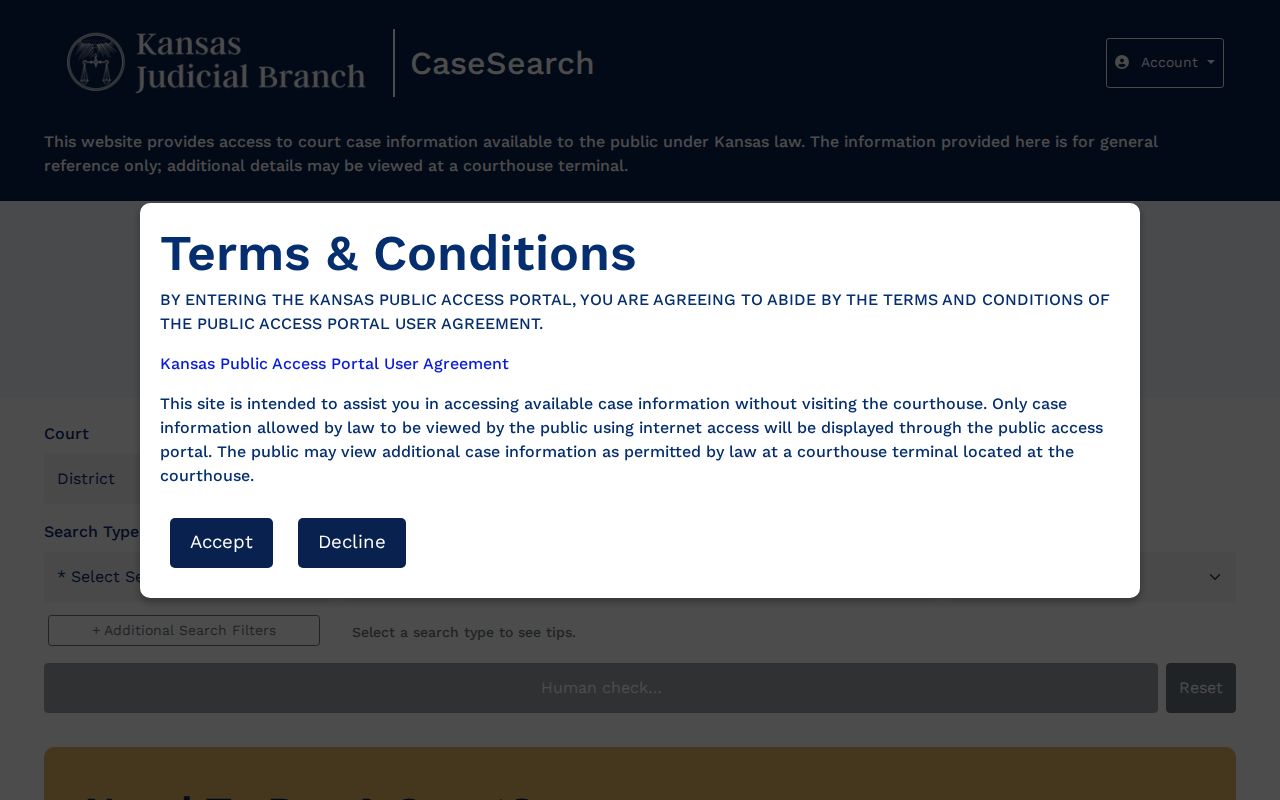
The screen confirms the public agreement and search labels that shape a Pratt lookup. A CAPTCHA error or an empty required field is a form problem, not proof that no case exists.
Criminal Dockets: What They Show
A register of actions is a short, chronological index. The header may identify the case number, caption, status, filed date, court location, judicial officer, parties, and attorneys. Entries can record a complaint, warrant, service, bond event, arraignment, motion, continuance, plea, judgment, sentence, appeal, or closure. The entry proves that an event was logged. It does not always reproduce the underlying order or explain its full effect.
| Case Number | Current examples use PR-YYYY-CR-######; older records may omit PR. |
|---|---|
| Charge(s) | The filed allegations and any public offense or statute labels. |
| Hearing Settings | Arraignment, pretrial, motion, plea, trial, and sentencing dates when public. |
| Plea | The plea entry shown by the court, which must be read in context. |
| Disposition | Dismissal, diversion, guilty plea, trial result, sentence, or another closing event. |
Pratt County Criminal Docket Outcomes
A filed charge is an allegation, not a conviction. An arrest, complaint, or warrant also does not state the final outcome. Read forward to the newest public entry and locate the plea, judgment, dismissal order, sentence, or closure event. A pending label can coexist with old settings, a warrant, a reset, or an appeal. The latest order controls more than a stale status line.
Read the exact label. Diversion and deferred adjudication are not interchangeable in every setting. A dismissal may also require the actual order to determine its scope. For an official result, request the judgment or sentencing document rather than relying on a short docket label.
Criminal Case Stages on the Docket
A state criminal case commonly begins with a complaint or other charging event. Service, warrant, bond, or first-appearance entries may follow. The docket then records arraignment, motion practice, discovery-related notices, pretrial settings, continuances, and later a plea or trial event. Judgment and sentencing entries document the court's action. Post-judgment motions or an appeal can continue the register after a disposition appears.
Docket flow: Charge Filed › First Appearance › Arraignment › Pretrial Settings › Plea or Trial › Judgment and Sentence
Pratt County Criminal Docket Caseload
Kansas Judicial Branch statistics for the period ending June 30, 2024 report 71 felony filings, 56 misdemeanor filings, and four criminal appeals in Pratt County. The same report counted pending cases by age. These figures describe court workload, not named defendants or case outcomes. They help explain why a single search result must be read on its own record.
The 2025 disposition table separately lists 88 felony dispositions and 83 misdemeanor dispositions. Its categories include diversion, dismissal, guilty plea, and other outcomes. Aggregate totals cannot establish what happened in a specific case.
Pratt County Criminal Docket Courts
Pratt County District Court holds Kansas felony and state-law misdemeanor dockets. It is part of the 30th Judicial District. The district clerk maintains the case register and public filings. The county clerk is a different office that handles county administration, so a request for a criminal pleading should go to District Court staff.
Pratt Municipal Court handles City of Pratt ordinance cases, including municipal citations. Its office is at 303 S Oak and its phone is 620-672-7131. Federal criminal matters leave Kansas CaseSearch and use PACER or the U.S. District Court for the District of Kansas. Checking jurisdiction first prevents a valid search term from being sent to the wrong database.
Missing Pratt County Criminal Docket Records
An online case-information result may appear without every pleading or order. Converted documents depend on the period and system covered by Kansas eCourt. Older or nonconverted material may be available at the public terminal inside Pratt County Courthouse, 300 S Ninnescah, Pratt. Call the District Court clerk at 620-672-4100 before traveling if a current setting or particular filing matters.
The official Pratt County District Court page is the court contact route. A written Kansas Open Records Act request should identify Pratt County District Court, the case number, the document title, and an approximate filing date. Ask separately whether certification is required. The separate KBI criminal-history check is not a substitute for the court docket.
The official Smart Search and kiosk material is captured below from the Kansas Judicial Branch instructions.
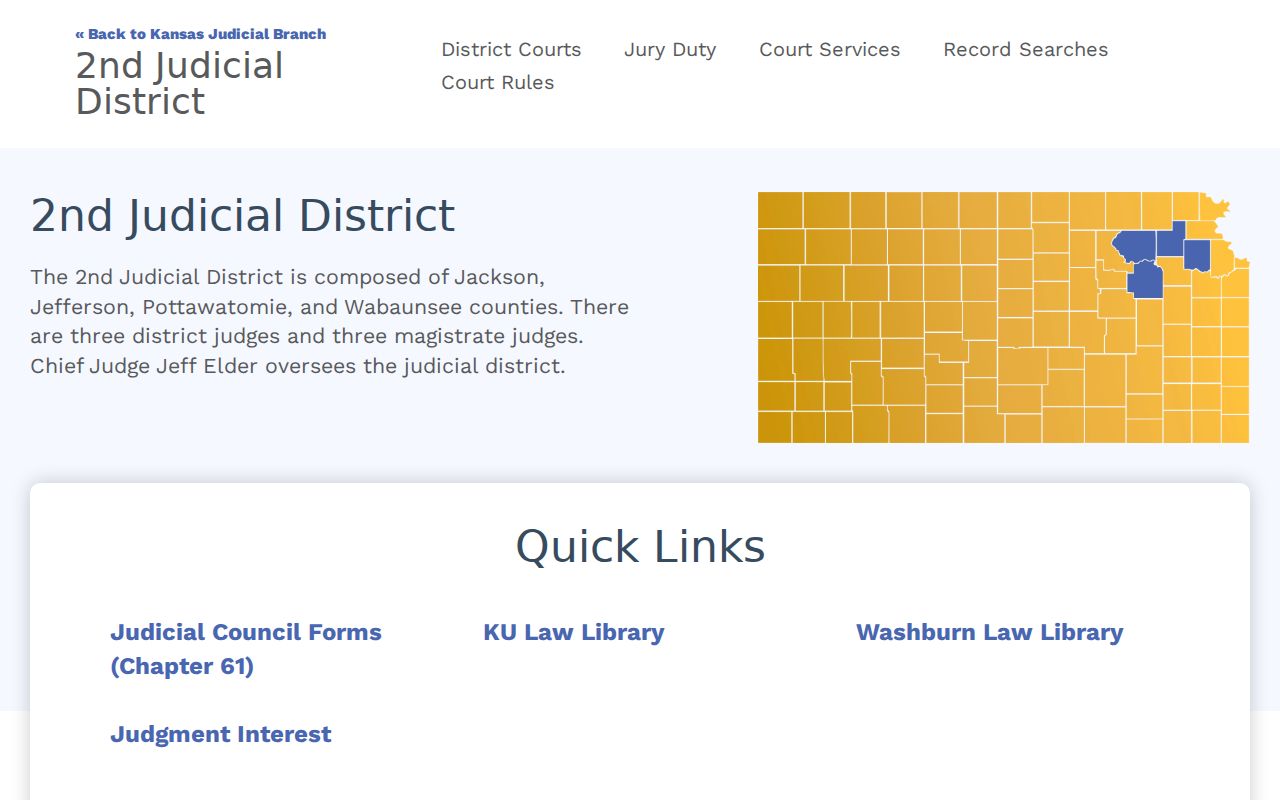
The instructions support the terminal fallback when web results are incomplete, while the same confidentiality rules still apply at the courthouse.
Access Rules for Criminal Dockets
Kansas Supreme Court Rule 22 governs public electronic district and appellate case records. Public access is broad, but not every case type or document appears online. Juvenile, adoption, mental-health, grand-jury, search-warrant, and other protected categories may be restricted or excluded. Personal identifiers must be redacted under Kansas rules. An expunged matter may be separated from ordinary public files, so no-result searches must not be treated as factual conclusions.
Kansas Open Records Act procedures provide a route for public court records that are not conveniently online, subject to court rules and exemptions. The custodian may separate exempt matter from material that can be released. Restricted access requires lawful authority; a public request does not override a sealing order.
Key Rules:
Kansas Supreme Court Rule 22 governs electronic access to public district and appellate case records.
K.S.A. 45-221 lists exemptions and supports separation of exempt from releasable material.
K.S.A. 22-2410 addresses expungement petitions and separation of expunged records.
Pratt County Criminal Dockets and KBI
A District Court docket is a court case register. It tracks filed charges, hearings, orders, and outcomes in that case. The Kansas Bureau of Investigation criminal-history service is a separate statewide product, and official materials describe a $30 search fee. Neither an online docket nor a KBI result substitutes for a certified court judgment.
Use CaseSearch to follow a known court case. Use the clerk for an official public filing. Choose the KBI route only when a criminal-history record, rather than a court docket, is actually required.
The distinction prevents several common errors. A docket may show that a complaint was filed without resolving the allegation. It may display a dismissal entry without reproducing the order's terms. A criminal-history response uses a different source and purpose, while a certified judgment comes from the court file itself. Match the channel to the record needed. For a current hearing or plea entry, start with CaseSearch and the Pratt clerk. For the text of a judgment or sentence, identify that document and request it. For a separate Kansas criminal-history product, follow the KBI process and its stated fee.
Federal criminal matters also sit outside both Kansas CaseSearch and the Pratt District Court register. Use PACER for the federal docket, then request a federal court record through the proper federal clerk route.